We build with Godot, an open source (MIT licensed) game engine, and help with migrating existing projects, technical support, and XR support. This page also explains why we choose Godot.
Godot is an open source game engine. Besides promoting Godot community activities in Japan, we are working with two partner companies to promote its use in Japanese industry.
We take on Godot work as custom development or by joining your project.

So what kind of engine is Godot?
Godot is an open source game engine for building 2D and 3D games and apps. It began as an in-house engine that Argentine developers Juan Linietsky and Ariel Manzur used for client work, and was released as open source under the MIT license in 2014. Since then it has been developed by a worldwide community of contributors, and today it is supported by the nonprofit Godot Foundation.
The name comes from Samuel Beckett's play Waiting for Godot. It reflects the idea of an engine that keeps gaining new features and is never quite finished.
Here are the three reasons we choose Godot.
Godot is open source software under the MIT license. You can use it for any purpose, and distribute modified versions commercially or under a different license. You also choose the license of the games and apps you make. When you redistribute Godot, you include its copyright notice and license text.
Godot has no engine fee, no runtime fee, and no revenue-based payments (royalties). Because the engine adds nothing to the cost, our quote covers only the development and support work itself, which keeps it easy to understand.
The Windows editor is ready to use as soon as you download it and extract the zip. Keeping the editor small is also one of Godot's development goals.
Exporting an app attaches your app data to a prebuilt engine runtime. Unless you modify the engine itself, there is no long engine compilation step. In the editor, changes to scripts and scenes can be applied to the running game as you work.
Godot, commercial game engines such as Unity and Unreal Engine, and Three.js, a 3D library for web browsers, are good at different things. Which one to choose depends on your requirements.
| Godot | Commercial game engines | Three.js | |
|---|---|---|---|
| Suited for | Building polished games, production in an editor, and exporting native apps or apps for XR headsets | Large-scale games and advanced visuals, with a wide market of assets and plugins and a long track record | Lightweight 3D display embedded in a browser, and integration with existing web services |
| Engine costs | Free | Depending on the engine and your revenue, paid per-seat plans, runtime fees, or revenue-based payments (royalties) may apply. | Free |
| Platforms | Windows, macOS, Linux, Android, iOS, the web (WebGL only), game consoles*1, and more | Windows, macOS, Linux, Android, iOS, the web*2, game consoles, and more | Web browsers |
| Game consoles, embedding in devices | Consoles are supported through third-party services such as W4 Games. For devices, there is experimental support for using Godot as a library inside your own application. | Consoles are officially supported by the engine vendor (developer registration for each platform, or a paid engine plan, may be required). | Assumes an environment that can run a web browser. |
| Performance | Runs as a native app. Heavy processing can be written in C++. | Runs as a native app, with a rich set of advanced rendering features. | Runs inside the browser, so it generally has some overhead compared with native apps. |
*1 For Godot, consoles are supported through third-party services such as W4 Games.
*2 Unreal Engine 5 does not officially support exporting to the web.
Performance varies a great deal with the content, so we cannot say in general that one is faster. When it matters, we measure on the actual device and decide from there.

It is not about which one is better. It is about choosing what fits what you want to make. We can build with Unity and Three.js too (see Client work). If you are unsure, just talk to us.
We work on both the technology of XR and games and the creative side, such as characters and experiences. You are welcome to talk to us from the planning stage.
Besides our CEO, Kobayashi, we have team members with experience in Godot projects.
We can also work together with the companies in our three-party MOU to promote Godot in industry: eSOL Co., Ltd. (strong in software development for industrial fields) and Tadano Infrastructure Solutions Co., Ltd. (which develops large industrial machinery and uses simulation technology), as described in the press release by Tadano (in Japanese).
Quoted according to your request
The Godot engine itself has no usage fees, runtime fees, or revenue-based payments. Our quote reflects the development and technical support you need.
Send us an email.
We sign a non-disclosure agreement (NDA) and, in parallel, hear about your goals and requirements.
Based on our discussion, we propose how to proceed and send a quote.
Once you are happy with the proposal, we sign a contract.
We carry out the development and technical support.
We deliver the finished work.
Our development work with Godot, our work to promote it in industry, and our technical writing and talks about the engine.
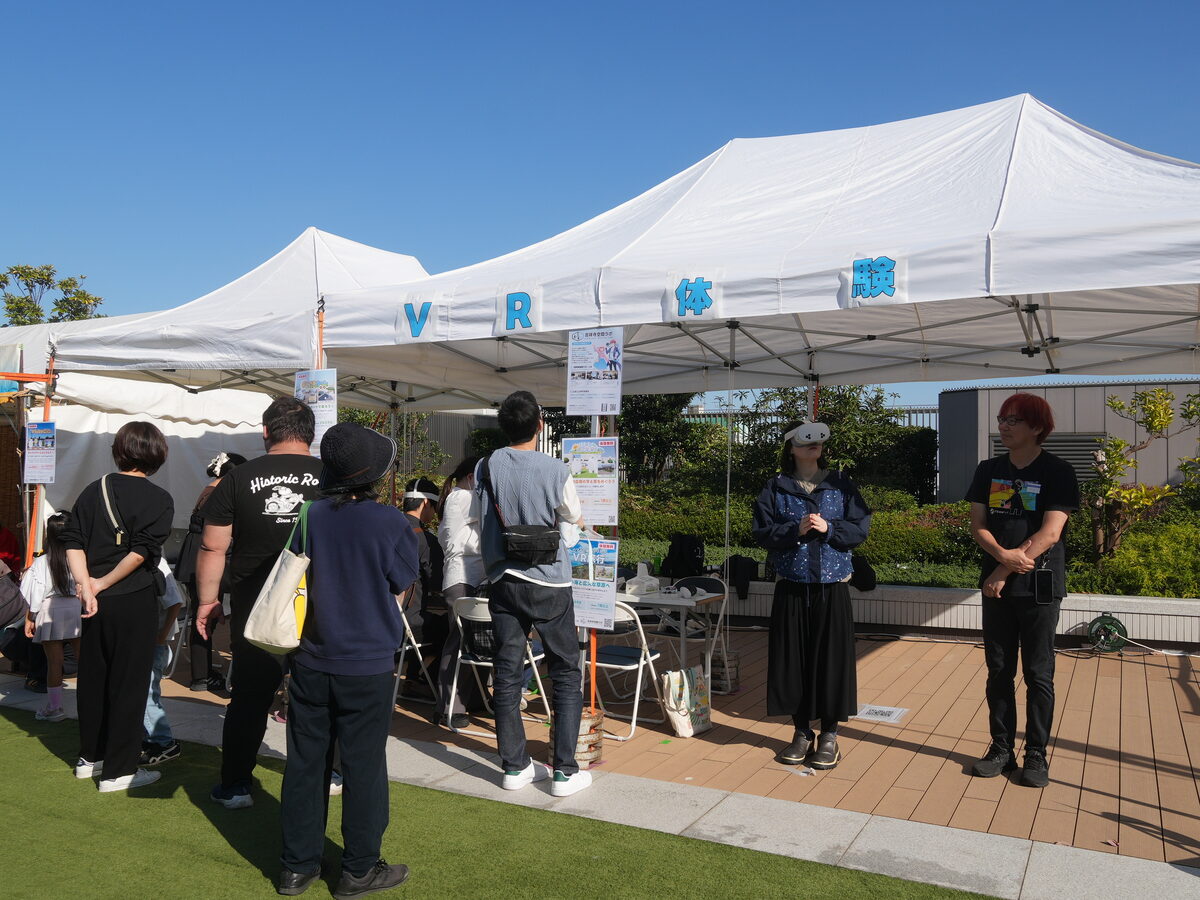
For our VR booth on the “Taiyo no Hiroba” rooftop (October 17–18, 2026), we built some of the MR experiences with Godot (press release, in Japanese).
Together with eSOL Co., Ltd. and Tadano Infrastructure Solutions Co., Ltd., we agreed to promote use of the game engine Godot in Japanese industry (press release by Tadano, in Japanese).
At the eSOL Co., Ltd. webinar “Industry × game engines” front line, our CEO Kobayashi presented an overview of the Godot engine and its background.
On our tech blog, we collect how-tos and tips for VR development with Godot. In September 2026, we updated it with what we learned building an MR app for Meta Quest 3 with Godot 4.7.2. Godot VR Notes, Godot Notes (both in Japanese)
December 14–16, 2022. Slides, in Japanese
December 21–22, 2023. Slides, in Japanese
If you are thinking about adopting or building with Godot, feel free to get in touch.